
The situation
Farmland Foods is a nationwide food manufacturer and meat processor operating under an MPI-registered Risk Management Programme and supplying to a major supermarket’s quality assurance standard. In that business, a camera system is not a security accessory. It is part of how the operation proves what happened: that the production process ran without interference, that no contamination event went unobserved, and that quality assurance claims are backed by something more than a written record.
Before Blue Eagle, that evidence sat across several standalone NVR systems. They were hard to use, they were not built for the people who had to use them, and coverage was incomplete. A system that is hard to interrogate is a system nobody interrogates until something has already gone wrong.
The gap was not a security gap. It was an assurance gap: the business could not consistently demonstrate what its own standards required it to demonstrate.
The approach
Blue Eagle came at the project as an advisory engagement rather than a camera sale. The starting question was not how many cameras the sites needed. It was what the business has to be able to prove, to whom, and how quickly.
That framing changed the design. Camera positions were driven by the production stages where interference or contamination would carry the greatest consequence, not by coverage of floor area. Recording and retention were set against how far back an assurance question could reach. And the platform was chosen so that every site would sit under one system rather than one system per site, because evidence split across recorders is evidence that takes a day to assemble. Positions were set through a full site survey and working sessions with Farmland’s management.
The delivery
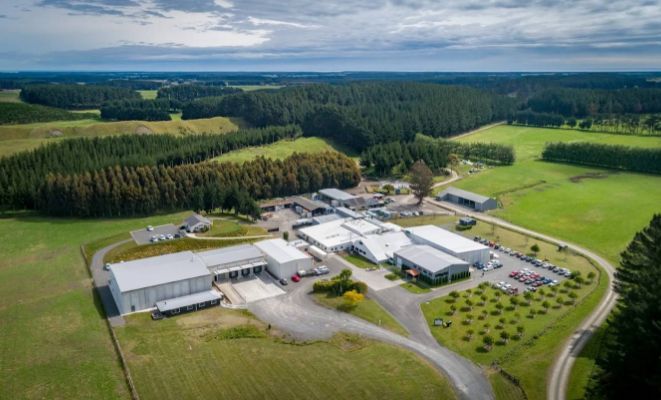
One platform, 3 sites, 50 cameras. Blue Eagle designed and installed a nationwide Wisenet system covering every site under a single management platform, giving site teams what they need locally and management a single view across the business.
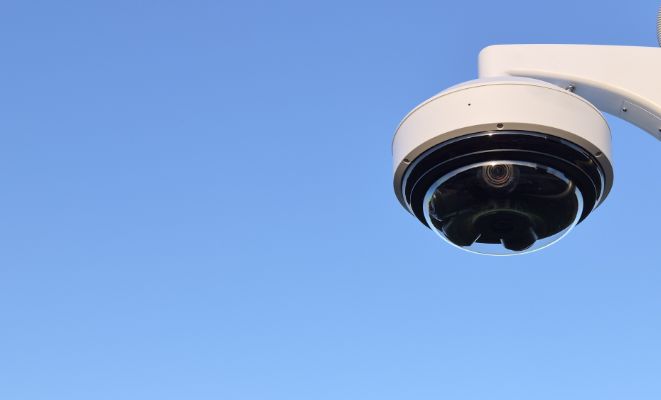
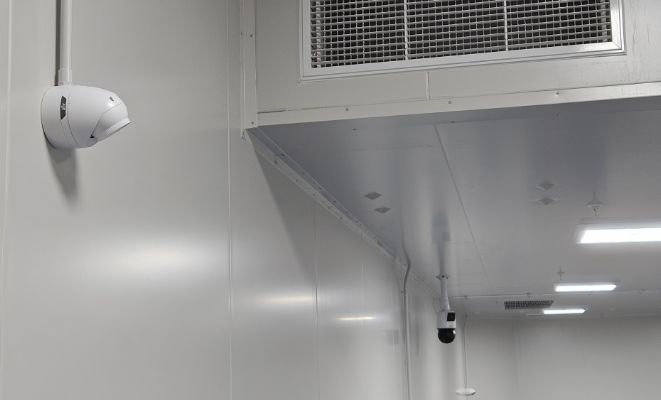
PTZ on the stages that carry the risk. PTZ cameras were positioned to give close, precise coverage of critical points in the manufacturing process, so an assurance question about a specific stage can be answered with detail rather than a wide shot of the room.
Live alerts, ready to switch on. The platform can raise live alerts for intrusion, PPE non-compliance, and people entering no-go areas, and send them to management, team leaders, and the health and safety and compliance managers. The alerts are not switched on yet. Turning them on is a configuration change, not a hardware replacement.
Built to extend. The design anticipates further sites in New Zealand. Adding a site is a configuration change on an existing platform, not a new system standing alongside the old one. That is the mistake the original estate made, repeated at every site. The next site is already planned: the head office in Bulls is scheduled to join the platform in early 2027.
The advantage
Footage retrieved, not hunted
The operations manager previously worked across fragmented systems to assemble footage. On the new platform every site sits in one system, so staff find an event and export it directly. AI search is ready to switch on as well: classification of people, vehicles by type, clothing colour, and the PPE a person is wearing, from gloves and glasses to hairnets, high vis, overalls, and boots, filtered from one search pane. The time recovered repeats with every request.
Step in while it is happening
Once the alerts are switched on, intrusion, PPE non-compliance and people entering no-go areas reach management in real time, so they can intervene while an incident is under way rather than finding it in the archive later. Switching them on is a configuration change, not a capital project.
Assurance you can produce on demand
The system was specified against what the business has to evidence, so the coverage exists at the points where a question is likely to be asked. That is the difference between a camera system that records and a camera system that answers. On the line, that means showing that no foreign object entered the product, and that food dropped on the floor did not go back into production.
A safety record as well as a food safety one
Coverage on the production stages also documents activity in areas where staff are not meant to be while machinery is running, and on tasks that carry an injury risk, such as cutting. When an incident or a near miss is reviewed, the footage shows what happened and whether the rules for those zones were followed. That supports the business’s health and safety duties as well as its audit obligations.
One estate, one standard
Every site now runs the same platform, the same interface, and the same retention. Staff moving between sites work one system, and a question that spans sites is answered in one place.
The ongoing relationship
The relationship has grown by extension rather than by contract renewal. Blue Eagle installed the original system and has carried out the subsequent additions as the business has expanded, which means the same team that designed the estate maintains it and understands why each camera sits where it does. A planned preventative maintenance (PPM) programme covering the full estate is the next step under discussion, moving the systems from responsive repair to scheduled care.
“From the initial install through to subsequent system extensions, the team has been professional, responsive, and technically competent. Their ability to quickly understand our requirements, provide intelligent recommendations, and implement solutions in a timely manner has made them a valued partner in our security infrastructure. We would confidently recommend Blue Eagle to any business seeking a robust, scalable security system backed by a knowledgeable and service-focused team.”
Eddie Davis, Managing Director, Farmland Foods.
Farmland Foods needed a camera system that could evidence a food safety standard, not just record a room. If your operation has to prove what happened on the line, and your current system makes that a day’s work, the conversation starts with a site assessment.