
MANUFACTURING & INDUSTIRAL
Who was in the restricted zone on Tuesday?
Most manufacturers can tell you who holds a card. Fewer can produce a timestamped record of who entered a restricted machinery zone on a given afternoon, without asking someone to go and look.
That gap is where WorkSafe obligations and access control systems meet, and it is the reason manufacturing sites call us.
A manufacturing site is not a building with people in it. It is a set of zones with different rules: areas where machinery is running and only inducted staff should be, areas where contractors work without your induction, R&D and design space where the exposure is intellectual property rather than injury, and a perimeter that has to stay open enough for goods to move.
Access control and cameras on a site like this do several jobs at once. They keep people out of places that could hurt them, they produce the record proving that they did, and with the right analytics they raise an alert while someone is in a no-go area or missing PPE, when there is still time to step in. The record is the job that gets discovered late, usually when someone asks for evidence and the answer is a folder of card assignments rather than a log.
The other pattern we see is systems that were expanded without a managed plan. A camera system from one project, an alarm from another, access control added when the extension went up, none of it managed together, and nobody able to say who is responsible once the manufacturer's warranty expires.
What your obligations actually require
WorkSafe duties
Your primary duty of care covers everyone on site, including contractors and visitors who never sat your induction. If a notifiable event occurs, the question is who was where, when, and whether they should have been. A system that logs entry and exit by zone answers that in minutes. Card assignment records do not.
Contractor management
Contractors are the highest-risk group on most manufacturing sites and the least controlled: they arrive on someone else's schedule, work in areas they are not familiar with, and leave. Time-bound access by zone, logged, tracked, and revoked automatically, is the difference between managing that risk and hoping.
Building warrant of fitness and Form 12A
If your access control secures fire doors, it sits inside your BWoF. Inspections run to a schedule with annual sign-off, and a system found non-compliant can mean you cannot occupy part of your own building until it is put right.
Intellectual property
Not a statutory obligation, but often the one that carries the highest value. Zone separation between production and design space with an audit trail is what turns an IP claim into something you can evidence.

What Blue Eagle does differently
We spend time inside your operation while it is running, before anything is specified, because a zoning matrix drawn from a 2D plan works differently in practice from one drawn from watching a shift. Then, where more than one platform is worth considering, we put the options in front of you with the trade-offs written down, including the downside of the one we recommend.
That method has a name: RADAR. Five stages, each producing something you keep, starting with a written assessment of your operation that is yours whether or not you choose Blue Eagle.
How we look after systems after installation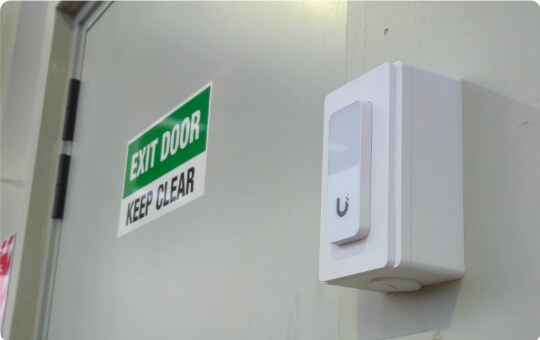
86 cameras, 36 doors, live intelligence on day one
Medifab manufactures high-specification wheelchairs and assistive devices across 6 locations. When designing a new manufacturing facility with the prospect of doubling capacity, they designed security in from the start rather than carrying fragmented systems into a larger space. The facility was commissioned with 86 AI-enabled cameras running intrusion detection and classification of people and vehicles at entry, with smoke and flame detection ready to switch on in software. 36 access-controlled doors and 4 gates on one platform, and expansion modules already in place so doubling the footprint does not require a new system from scratch.
Read the Medifab case studyStart with an honest read of where you are
Time on your site, then a written assessment covering what you have, what your obligations require, and the gap between them. Yours to keep, whether or not you choose Blue Eagle.